
Three things to consider to determine what really is the “best solar panel” for your Sunshine Coast home.

Not all panels are built equally. There are many things that separate the good from the bad. When you are deciding on solar panels for your Sunshine Coast home, here are the main factors to consider 

Power Tolerance

The power tolerance tells you the extent to which a panel will perform at its stated power output. Power tolerance is expressed as a percentage above and below the power output. For example a 200w panel with a power tolerance of +/- 5 % will produce between 190 and 210w under standard testing conditions. As the power tolerance applies to all panels in a system you may find that a 2.4 kwh system with a power tolerance of +/- 5 % only produces 2.3 kWh. The better panels on the market have a power tolerance of – 0 + something in other words they may over perform but they won’t underperform.


Temperature Coefficient

 The temperature coefficient tells you the loss in output for every degree the panel temperature rises above the standard testing temperature of 25⁰C. For example a 200 W panel with a temperature coefficient of -0.5% that has warmed up to 45⁰C will have an output of 180W (200 W – 20 * 0.5 * 200).   Panels are exposed to direct sunlight and can get quite warm, (especially on the Sunshine Coast) so the temperature coefficient can therefore have a big impact on the performance of your system. Generally, the lower the number, the better the panel will perform in our warm conditions.


Modular efficiency

This refers to the efficiency with which a panel converts sunlight into electricity. At present most panels have a modular efficiency of around 15% with the best performing pv panels at around 24%. The modular efficiency does not directly influence the performance of a system, only its size, i.e. a less efficient system will need more surface area to generate the same power output.
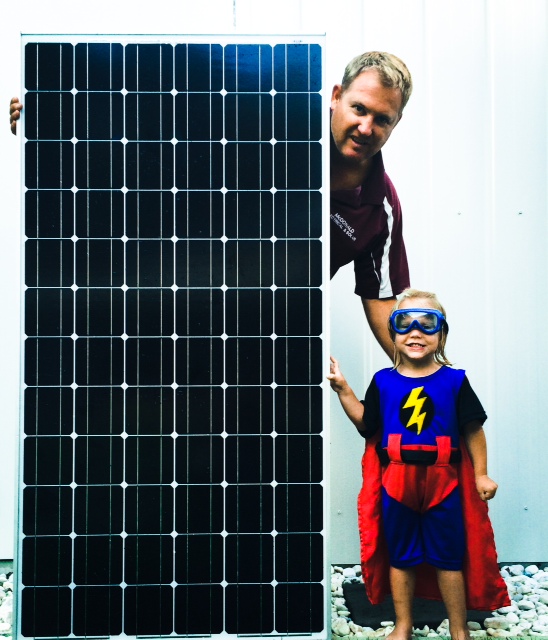
 

The Value of Solar Power

photo 1

Dave McDonald, his daughter “Solar girl” and family, have made Mooloolah their home because they value community. David and his brother Troy McDonald are solar power specialists running McDonald Solar and Electrical. They are passionate about quality and value solar power, having installed around 1100 systems on the Sunshine Coast over the last 7 years. Many local clients value their service for being friendly, helpful, quality installers andcommunity members.


Dave has a simple message about the value of solar. If you went to the bank with $5000- $6000 and they offered to give you $3600, plus a minimum of 10%-20% return per year on your investment, guaranteed over 25+ years, increasing over time, you would grab it with both hands. Essentially, that is what solar power offers and more. “Even after the removal of the 8c feed in tariff, solar power still offers a huge return on what is a small investment, which will only get bigger as electricity prices increase” Dave added.


“Australians love new cars, but their value depreciates quickly. In fact, the average new car will depreciate in value equivalent to the cost of a 5 kW solar system within a couple of years. So, if you’re planning to stay in your home for 3 years or more, it’s a no-brainer to get solar power installed.” Dave says.


The government is still offering incentive of around $3600, to help with the upfront cost of purchasing a 5kW solar power system. However, these incentives are consistently being looked at and how long they last for is anybody’s guess. What this means is, that if you are considering or have ever thought about purchasing a solar power system, Dave suggests you should act now.